



At the gates of the 4-star hotel du Côté des Olivades is Provence, our dear and tender Provence where life is so good all year round. During your stay at the b design and spa hotel, we invite you to explore in the Alpilles and Luberon, but also in the other corners of our beautiful region, where the picturesque villages and local markets will give you as many memories as emotions.
A real trip to the heart of the Alpilles
The Alpilles are made up of 10 villages: Saint-Rémy-de-Provence, Eygalières, Les Baux-de-Provence, Maussane-les Alpilles, Fontvielle, Mouriès, Le Paradou, Aureille, Saint-Etienne-du-Grès and Mas-Blanc -les-Alpilles.
Between breathtaking landscapes, picturesque villages, gastronomy and crafts, the Alpilles will offer you an unforgettable moment.
Take a colorful trip to the Lubéron!
A land where the red of the cliffs mingle with the ocher nuances of the different villages and where the Provençal sweetness lulls the song of the birds.
- We recommend that you take a walk in the Cedar Forest, a spectacular place in the Luberon Regional Natural Park to discover ancient trees. Over nearly 10km, you will take pleasure in breathing the scents of the undergrowth. To extend the walk, head for the ocher trail for a colorful experience. This emblematic place of the Park offers you incredible nuances, between red, orange and yellow: a real palette of artist!
- Colorado Provençal is one of the geological curiosities that you must see at least once in your life, you will take the most famous path in Colorado: the Sahara road. Young and old alike remain amazed at the geological shapes and the dazzling colors of the site.
- On the famous greenway of Calavon, the spring landscapes display their colors: green nature, flowering shrubs, fields of poppies ...
- Among the most beautiful villages in France, Lourmarin is a hymn to Provençal gentleness and aesthetics in the heart of the Luberon. His castle would even be "La Villa Medicis" in Provence. On the Vaudois route, it stands out as one of the essential stages.
The Calanques of Marseille
To visit on foot or by boat, the Calanques National Park of Marseille is full of coves and paradisiacal beaches
which follow one another for more than twenty kilometers on the shores of the Mediterranean coast.
- The Monte Rosa: A veritable treasure of biodiversity, Mediterranean vegetation and limestone rock mingle with the landscape to immerse you in total immersion in this still wild territory.
- L'Escalette: Formerly an industrial and military zone, the vestiges of the past make it a place of open-air exhibitions of works of art.
- Les Goudes: This calanque has long been a fishing port, today a marina. Many vestiges are to be discovered such as the huts and the typical alleys ...
- Le Cap Croisette: A unique place where land and sea meet, thus separating the cape from Île Maïre. A magnificent panorama will be offered to you!
- Callelongue: Nicknamed the "end of the world" by the Marseillais, this calanque was notably a high place of cinema and is still animated by a friendly bar-restaurant.
- The Calanque de Marseilleveyre: Breathtaking view of the Riou archipelago and isolated sandy beach, are all assets that contribute to the beauty and charm of the place.
- Sormiou: A very popular summer resort with its turquoise waters, it is a real paradise for divers. Indeed, the seabed is rich and more particularly shelters a Posidonia herbarium.
- Morgiou: More intimate and discreet hamlet than Sormiou, heir to the fishing of yesteryear, it is a pretty cove highlighting fishing and where you can taste very good fish.
- Sugiton: Culminating at 245 meters, the Sugiton belvedere offers a breathtaking spectacle with its many exceptional views over the entire Calanques National Park, a change of scenery guaranteed!
- The cliffs of Devenson: Vertiginous, they display a preserved landscape where nature has entirely modeled the cliffs sheltering an exceptional biodiversity where many birds find refuge.
The Calanques of Cassis
- The Calanque de Port-Miou: A meeting place for many boats, this charming calanque is an ideal place to stroll and get lost in the surrounding trails.
- The Calanque de Port-Pin: Close to the Calanque de Port-Miou, you will be amazed by the beauty of the place: fine sandy beach and turquoise water are waiting for you to enjoy a good swim in paradise.
- The Calanque d'En-Vau: Bathed by the sea, this calanque has been dug by erosion and is very popular with tourists in summer. Mediterranean vegetation, salt water and rocks merge to make it a unique and very welcoming place.
The Camargue
Wild landscapes and exceptional panoramas as far as the eye can see, La Camargue displays a symbiosis between people and the different animals that live there. Preserved natural territories, to be visited on foot, by bike or even on horseback, you will be able to discover an astonishing diversified flora and fauna. Vast about 100,000 hectares, you can also admire the cultures, the salt marshes and the lagoons in complete freedom.
The Careers of Light
In addition to this, you need to know more about it.
Located in Baux-de-Provence, Les Carrières de Lumière is an exceptional place dedicated to the projection of sound and light shows on walls, which once formed part of old quarries. Through immersive exhibitions, you will rediscover the works of certain artists, notably at the moment, the paintings of Paul Cézanne, member of the Impressionists and precursor of the Cubism movement.
A little history...
Today recognized as a "classified natural site", the quarries of Val d'Enfer from which the white limestone came, were exploited to build the City of Baux; they reached their peak after 1850. In 1935, they unfortunately closed their doors due to very strong competition with the appearance of new building materials such as steel or concrete, economically more interesting and modern.
A new page opens ...
In 1959, the Carrières reopened their doors to serve projects of an artistic nature led by Jean Cocteau, who fell in love with the place after having visited it. Theater or cinema scenes are then shot in particular "Le Testament d'Orphée", a film by Jean Cocteau. The quarries then know in 1975, a new patron Albert Plécy, journalist of the liberated Parisian who will transform the quarries into Cathedral of Images: the idea of adorning the walls with light will thus be born ...
Baptized "Carrières de Lumière" in 2012, the management of the place is entrusted to another actor in order to develop an innovative concept: AMIEX: Art & Music Immersive Experience.
Glanum archaeological site
Located in Saint-Rémy-de-Provence, more precisely in the heart of the Alpilles, the Glanum site is a Gallic city with Greek and Roman influences.
A true sanctuary, you can discover religious architectural remains such as the mausoleum or the triumphal arch of Glanum and admire an exceptional panorama!
The ornithological park of Pont-de-Gau
Located in the Regional Natural Park of Camargue, the Ornithological Park of Pont-de-Gau is a real invitation to travel and discovery.
color:#1E1E1E">Composed of 60 hectares of ponds, marshes ... this protected park is the meeting place of more than two hundred species of birds such as pink flamingos. Thus, it is an ideal place to observe and photograph birds and also to walk in contact with unspoiled nature, since it stretches over more than seven kilometers of walks.
color:#1E1E1E">Between proximity to nature and discovery along the trails: immerse yourself in the intimacy of the fauna!
The ancient theater of Arles
One of Arles' must-see places, the ancient theater is an integral part of the city's landscape.
Erected during the reign of the Emperor Augustus, during the period of urbanization by the Roman colonists, the theater was built in the 1st century BC, on three levels of terraces that can accommodate 10,000 spectators.
For many years, the theater has hosted comedies, tragedies, Roman and Greek pantomimes aimed at a sophisticated audience.
In the Middle Ages, some of the stones making up the monument were used for the construction of Saint-Trophime, the cathedral of Arles.
Today the remains of the ancient theater is open to visitors and also hosts performances and plays.
The Castle of Baux-de-Provence
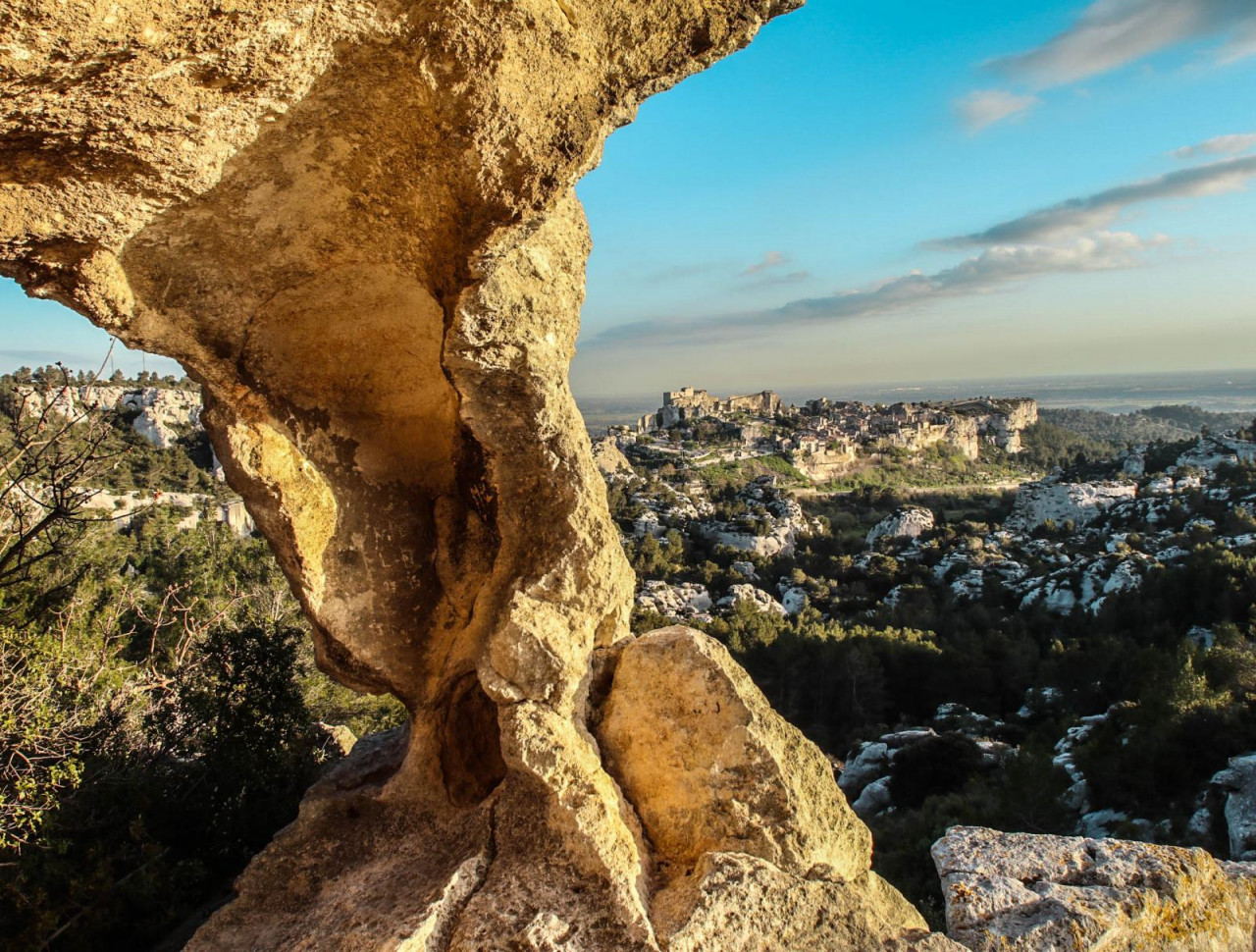
Perched on a rocky mountain, in the Alpilles massif, the majestic Château des Baux-de-Provence will amaze you with its remains and its breathtaking panorama.
Built for the lords of Les Baux in the 11th century, one of the most influential families in Lower Provence in the Middle Ages, the castle suffered several assaults. Indeed, at the time, it was a very coveted stronghold because it was well located, from which one could easily observe the surroundings.
Today, this fortress is a must-see place bearing witness to vestiges of the past such as troglodyte houses, the Saracen tower, the castle chapel ... You will be able to discover a little history linked to Provence while enjoying a breathtaking view of the Alpilles regional park: vineyards, olive groves, hills as far as the eye can see ...
Saint Sixte Chapel
Located two kilometers from Eygalières, the Romanesque Saint Sixte chapel was built on a rocky plateau where there used to be a Roman temple dedicated to Sylvanus.
It is a place of worship, a must to visit, rhyming with nature and authenticity: a real gem of Provence.
Gard's Bridge
A masterpiece of Roman architecture, the Pont du Gard is a three-level vestige spanning the Gardon in the town of Vers-Pont-du-Gard. It is part of a 52 km long aqueduct connecting Uzès to Remoulins, near Nîmes.
49 meters high and composed of three rows of superimposed arches, it is an impressive Provencal wonder.
The Palace of the Popes of Avignon
Listed as a UNESCO World Heritage Site, the Palais des Papes is one of the most unmissable historical monuments in Provence.
Built on the Rocher des Doms which overlooks the left bank of the Rhône, the fortress dominates the city of Avignon.
From 1309 to 1377, seven popes followed one another in this pontifical palace which housed the center of the Catholic Church: monument of the medieval apogee.
This religious masterpiece invites you to discover the many vestiges of Gothic architecture left by the various pontiffs who inhabited these places, the construction of which was supervised by Pierre Poisson.
Your market is set up on Wednesdays in the heart of the historic center and on the Place de la République but also on Saturday on Avenue de la Resistance.
Your market is nestled on Place Henri Giraud every Thursday.
Every Tuesday, find your market in the village of the hotel on the Place de la Marie.
Eygalières market
Located in the center of the village, the colorful Eygalières market is held on Friday mornings. Local local and artisanal products will delight young and old.
The Moulin Cornille
Having become a cooperative in 1924, the Moulin Cornille is recognized all over the world for its qualitative olive oil with a unique "black fruit" taste. Prized by the great starred chefs, the mill holds many regional and national awards thanks to their wide and diverse range of great wines of PDO-labeled olive oils.
The Moulin Castelas
Created in 1997, the Moulin de Castelas is made up of old olive trees exploited on the southern side of the Alpilles located in Baux-de-Provence. 45 hectares in Protected Designation of Origin of the Vallée des Baux de Provence and 65 hectares in the plain of Crau: these olive oils express beautiful aromas and the crunchiness of the olive.
The Alpilles wine route in 4 stages
An oenological escape ...
Unique terroir and recognized know-how, discover the wine estates in the heart of the Alpilles.

Stage 2: Domaine du Château Romanin in Saint-Rémy-de-Provence
Stage 3: Domaine de Valdition in Orgon
Stage 4: Domaine de Lauzières in Mouriès
Domaine of the Mas de la Dame
Spread over 57 hectares, the area of Mas de la Dame leads vineyards mani ry s e agro and carefully selects its plots to produce wines telling the story of the area and r e v e lators from Provence.
Domaine du Château Romanin
At the foot of the remains of a ch â teau Templar dating from the thirteenth me if th century, the area of Ch â teau Romanin s' e tends 250 hectares including 58 hectares of vines conducted biodynamic since planting. Producing wines made from uniquely Provençal grape varieties with extraordinary know-how, the Charmolüe couple tend to develop generous wines of quality.
Domaine de Valdition
color:black">90 hectares of vines cultivated using an agrobiological approach since 2006 make up the Domaine de Valdition, located in Orgon in the heart of the Alpilles regional natural park. The fruit of work that respects the environment and rooted in a passion for their land, the Domaine de Valdition produces quality, creative wines.
Domaine de Lauzières
Founded in the 16th century, the Domaine de Lauzières promotes organic and biodynamic cultivation under the Demeter label. The quality of the vines as well as the know-how of the house make it possible to produce quality natural wines combining harvesting tradition and innovation, in particular with the installations for the vatting of wines.